Interior Design Licensure Calculator
Calculate your licensure timeline
Estimate the years required to become a licensed interior designer based on your educational path and experience.
Based on NCIDQ requirements in North America (U.S. and Canada).
Your licensure timeline
Why this matters: As mentioned in the article, interior design requires 5-7 years total. This calculator shows how your choices affect the timeline.
People often assume interior design is all about picking colors and arranging sofas. If that’s what you think, you’re in for a surprise. An interior design degree isn’t just about taste-it’s a mix of technical skill, psychology, building codes, and project management. It’s not the easiest degree, but it’s not impossible either. Whether you’re dreaming of designing luxury homes or sustainable offices, you need to know what you’re signing up for.
What you’ll actually study in an interior design program
Most accredited interior design programs in the U.S., Canada, Australia, and New Zealand follow the same core structure. You won’t spend your first year sketching chandeliers. Instead, you’ll start with interior design fundamentals: space planning, drafting, materials, lighting, and human ergonomics. These aren’t optional electives-they’re the foundation.
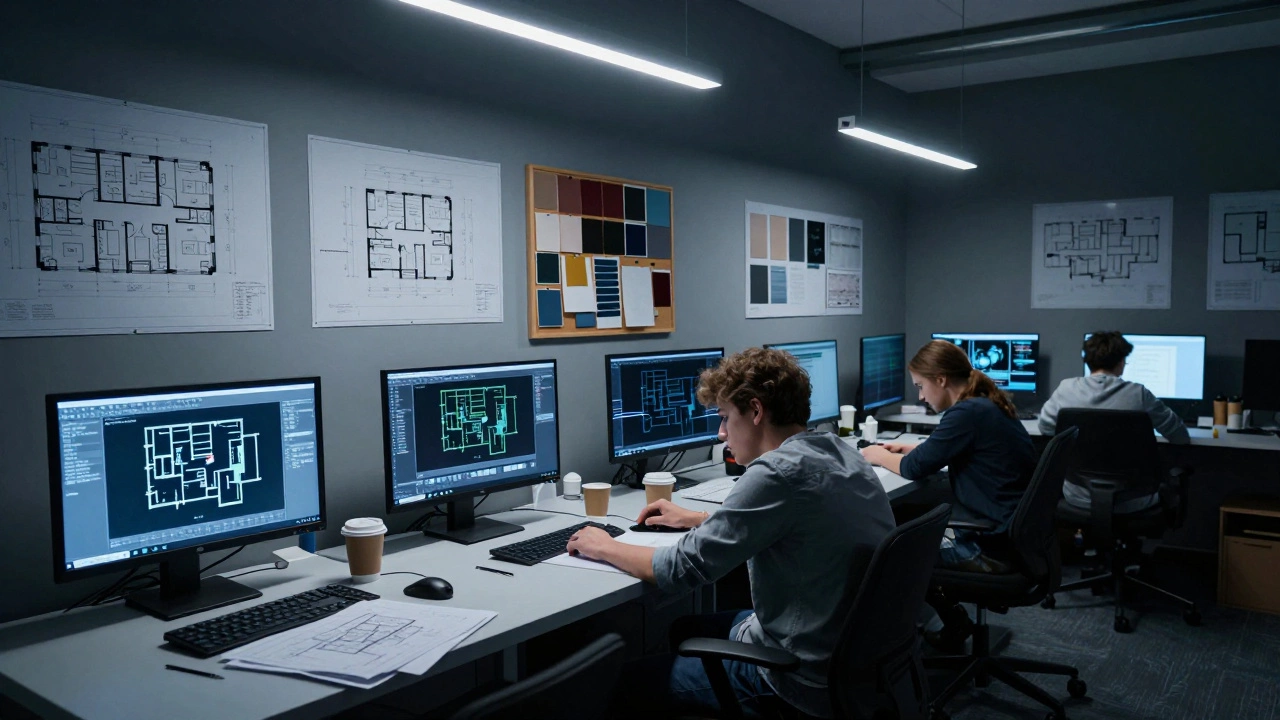
By semester two, you’re learning CAD software like AutoCAD and Revit. By semester four, you’re calculating load-bearing walls and fire exit requirements. By semester six, you’re submitting full construction documents for a mock apartment renovation. You’ll study building codes like the International Building Code (IBC) and ADA accessibility standards. You’ll learn how to read structural plans. You’ll memorize the flame spread ratings of fabrics. You’ll calculate lighting foot-candles for a hospital ward. None of this is glamorous. But if you skip it, you’ll fail.
Studio classes are the heart of the program. You’ll work 60-80 hours a week during finals. One student in Wellington told me she pulled three all-nighters in a row during her final project. Her team had to design a senior living center with dementia-friendly layouts. They got an A. But she didn’t sleep for 48 hours.
The hardest parts no one talks about
Many students think the toughest part is drawing perspective sketches. It’s not. The real challenges are:
- Managing clients who change their minds every week. You’ll spend hours on a design, only to have a client decide they hate the color you spent three weeks selecting. You learn to build flexibility into every plan.
- Dealing with contractors who ignore your specs. A plumber once told a classmate, “I know how to install this sink better than your drawing.” You’ll learn to document everything-and carry a camera everywhere.
- Staying within budget while keeping it beautiful. A $20,000 kitchen renovation isn’t just about cabinets. It’s about balancing quartz countertops, LED lighting, plumbing upgrades, and labor. One wrong choice and you’re over by $5,000.
- Passing the NCIDQ exam. In the U.S. and Canada, you need this license to sign off on commercial projects. It’s a three-part exam that covers everything from electrical systems to acoustics. The pass rate? Around 50% on the first try.
And then there’s the emotional toll. You’re not just designing spaces-you’re designing people’s lives. A client’s home might be their only safe space. A hospital room might affect recovery time. That pressure doesn’t show up on a syllabus, but it’s real.
Who thrives in interior design school?
Not everyone who loves Pinterest succeeds. The students who graduate strong have a few things in common:
- They’re detail-oriented. They notice if a door swing blocks a wheelchair path. They check if a light switch is at the right height for a child.
- They’re good with numbers. You’ll do square footage calculations, material takeoffs, and cost estimates daily. If math gives you anxiety, you’ll struggle.
- They can take criticism. Professors don’t sugarcoat. Your design might get ripped apart in front of the class. You learn to separate your ego from your work.
- They’re persistent. You’ll fail a project. You’ll get a C on a construction drawing. You’ll cry in the studio. But you keep going.
On the flip side, students who think they can wing it with good taste often drop out. Interior design isn’t about being artistic-it’s about being precise.

How it compares to other design degrees
Let’s be clear: interior design is harder than graphic design, fashion design, or even architecture in some ways.
| Aspect | Interior Design | Graphic Design | Architecture |
|---|---|---|---|
| Technical Requirements | Building codes, structural systems, electrical plans | Software (Adobe Suite), color theory, typography | Structural engineering, seismic design, zoning laws |
| Math Intensity | High (calculations daily) | Low | Very High |
| Licensing Required | Yes (NCIDQ in North America) | No | Yes (ARCH exam) |
| Typical Work Hours in School | 60-80/week | 40-50/week | 70-90/week |
| Real-World Impact | Health, safety, accessibility | Branding, communication | Structural safety, urban planning |
Interior design sits in the middle. You don’t need to design a bridge like an architect. But you need to know how the walls hold up. You don’t need to design a logo like a graphic designer. But you need to know how color affects mood and productivity. That blend makes it uniquely demanding.
Is it worth it?
Yes-if you’re ready for the grind. The job market for interior designers is growing. In New Zealand, demand for sustainable, aging-in-place, and small-space design is rising fast. In the U.S., the Bureau of Labor Statistics projects 5% growth from 2022 to 2032. That’s faster than average.
Entry-level salaries start around $40,000-$50,000 in the U.S. and NZ$50,000-$65,000 in New Zealand. With experience and licensing, you can hit $80,000-$120,000. Many designers start at firms, then open their own studios. Some specialize in healthcare design, hospitality, or even virtual staging for real estate.
But money isn’t the only reward. One graduate in Auckland told me she redesigned a child’s hospital room with calming colors and tactile walls. A year later, a nurse told her the kids were calmer during treatments. That’s the kind of impact you get in this field.

What to do if you’re unsure
If you’re hesitating, try this:
- Take a free online course on Coursera or edX-look for “Fundamentals of Interior Design” from a university like RMIT or Parsons.
- Volunteer to help a local nonprofit redesign a community space. See how much paperwork, permits, and meetings are involved.
- Shadow a licensed designer for a day. Ask to see their construction documents. You’ll either be fascinated or overwhelmed.
If you still feel excited after that, go for it. If you feel drained, consider a related path-like furniture design, spatial planning, or even real estate staging. You don’t need a full degree to work in design. But if you want to lead projects, sign off on safety plans, or call yourself a professional? Then you need the degree.
Is interior design a good career for someone who’s not artistic?
Yes, if you’re organized and detail-focused. Interior design isn’t about being a painter or sculptor. It’s about solving problems: How do you make a small apartment feel spacious? How do you reduce glare in a home office? How do you make a bathroom accessible for someone with mobility issues? Technical skills matter more than sketching talent.
Do you need to be good at math for interior design?
You don’t need to be a mathematician, but you need to be comfortable with measurements, ratios, and calculations. You’ll calculate square footage for flooring, determine lighting levels in lumens, estimate material costs, and adjust scales on blueprints. Most programs require college-level algebra. If you struggle with math, get tutoring early.
Can you become an interior designer without a degree?
Technically, yes-but only for residential projects in some places. In New Zealand, Australia, and most U.S. states, you can’t legally sign off on commercial projects or alterations to load-bearing walls without a degree and license. Many clients won’t hire you without credentials. A degree opens doors to bigger projects, insurance, and professional credibility.
How long does it take to become a licensed interior designer?
It usually takes 5-7 years. A bachelor’s degree is 4 years. Then you need 2-3 years of supervised work experience under a licensed designer. After that, you take the NCIDQ exam. Some people take longer if they work part-time or retake the exam. It’s not a quick path, but it’s a clear one.
What’s the difference between interior design and interior decoration?
Interior decoration is about aesthetics-choosing paint, curtains, and furniture. Interior design includes all of that, plus structural changes, lighting systems, plumbing, electrical, safety codes, and building regulations. Designers can decorate. Decorators can’t design. That’s why only designers can legally alter walls or install built-ins in commercial spaces.
Final thought: It’s hard-but it’s meaningful
An interior design degree isn’t easy. It’s long, expensive, and demanding. But if you care about how spaces affect people-how light changes mood, how layout influences movement, how accessibility transforms lives-then it’s one of the most rewarding paths you can take. You’re not just making rooms look nice. You’re making them work better. And that’s worth the struggle.