Builder vs. Contractor: Role Verification Quiz
Are you sure you know who to hire for your next project? Answer these 5 questions based on the article to find out if you can distinguish between a Builder and a Contractor.
Loading question...
Your Result
Analyzing your performance...
Ever stood on a job site and wondered why the person holding the blueprint is called a "contractor" when they are clearly building something? It’s a common mix-up. In New Zealand, we often say "builder," but in the US and many other parts of the world, "contractor" is the standard term. The confusion isn't just semantic; it reflects a deep shift in how construction work is organized, paid for, and legally managed.
The short answer? A builder constructs. A contractor contracts. But in practice, these roles have merged into a single professional who manages both the physical creation of a structure and the legal agreement that governs it. Understanding this distinction helps you hire the right person for your next renovation or new build, ensuring you aren't paying for services you don't need-or missing out on protections you deserve.
The Historical Roots of the Terms
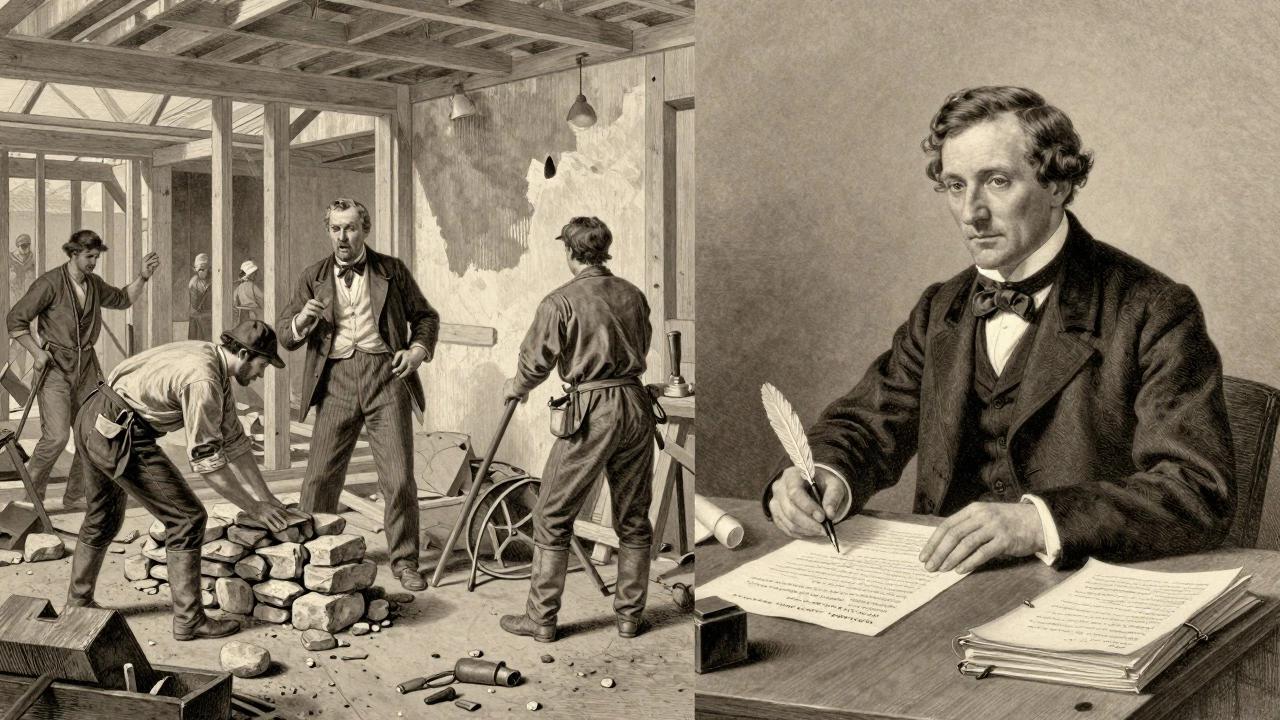
To understand the language, you have to look at the history of labor. In the early days of construction, there was no such thing as a general contractor. If you wanted a house built, you hired a mason for the walls, a carpenter for the frame, and a plasterer for the finish. Each specialist worked independently. You, the homeowner, were essentially the project manager. You bought the materials, coordinated the schedule, and dealt with disputes between trades.
This model was chaotic. Mistakes happened because no one had the big picture. Enter the figure of the Contractor is a party who enters into a contract to perform work or supply goods for another party. Originally, this person didn't necessarily hold a hammer. They held a pen. Their job was to negotiate prices, secure materials, and ensure the various specialists delivered on their promises. The term "contractor" literally comes from the act of contracting.
Over time, the line blurred. As projects became more complex, the person managing the contract started overseeing the actual labor. By the 19th century, the "general contractor" was a distinct role: someone who took full responsibility for delivering a finished product. Meanwhile, the word "builder" remained rooted in the physical act of constructing. In countries like New Zealand and the UK, "builder" stuck as the primary title for residential professionals. In the US, "contractor" won out, likely because the legal aspect of the relationship was considered more critical than the manual skill.
Builder vs. Contractor: What’s the Actual Difference?
While the terms are often used interchangeably today, there are subtle differences in scope and expectation. Here is how the two roles typically break down in modern practice:
- Builder: Traditionally focuses on the execution. This person (or company) is responsible for the quality of the workmanship, the selection of materials, and the adherence to local building codes. In NZ, a licensed builder is specifically authorized to carry out certain classes of building work and must be registered with the Ministry of Business, Innovation and Employment (MBIE).
- Contractor: Focuses on the delivery. This person manages the timeline, budget, subcontractors, and client communication. They are liable for the outcome defined in the written agreement. If the roof leaks, the contractor is responsible, even if a specific roofer made the error.
In a small residential job, these hats are worn by the same person. You hire a "builder" who also acts as your "contractor." However, in large commercial projects, you might hire a General Contractor (GC) who then hires specialized builders for different phases-structural steel, concrete, interior fit-out. The GC doesn't lay bricks; they manage the people who do.
| Feature | Builder | Contractor |
|---|---|---|
| Primary Focus | Physical construction and craftsmanship | Project management and contractual obligations |
| Liability | Quality of workmanship | Delivery against contract terms |
| Subcontracting | May hire helpers or specialists | Manages multiple specialized trades |
| Common Usage Region | New Zealand, UK, Australia | United States, Canada |
| Key Document | Building Permit / Code Compliance | Written Contract / Scope of Work |
Why the Confusion Matters for Homeowners
So, does it really matter what you call them? Yes, if you know where to look. When you hire a professional, you are entering a legal relationship. The title on their business card tells you little about their competence, but it can hint at their operational model.
If you hire a "builder" in New Zealand, you expect them to be registered under the Building Act 2004. This registration ensures they have the necessary insurance and competency to sign off on compliance. If you hire a "contractor" in the US, you check for state-level licensing, which varies wildly by state. Some states require a license for any work over $500; others only require it for structural changes.
The biggest risk arises when you confuse a handyman with a licensed builder/contractor. A handyman fixes things. A builder/contractor builds structures. If you ask a handyman to move a load-bearing wall without a permit, you’re not just risking bad work-you’re risking a failed inspection that could block your sale later. The "contractor" part of the title implies a level of accountability that a casual worker doesn’t have.

The Role of Subcontractors in the Mix
You’ve probably heard the term "subcontractor." This adds another layer to the naming puzzle. A general contractor (or builder) rarely does all the work themselves. They hire electricians, plumbers, and drywallers. These are subcontractors.
Here’s the key: You usually only have a direct legal relationship with the general contractor/builder. The subcontracts are between the GC and the subs. If the plumber messes up, you don’t sue the plumber directly; you go through the GC. This is why the "contractor" label is so powerful-it centralizes liability. The GC takes on the risk of managing dozens of different trades and ensures the final product meets your expectations.
However, this system has a flaw. If the GC goes bankrupt halfway through your kitchen renovation, you might find yourself chasing unpaid subcontractors for warranty claims. This is why checking references and verifying insurance is non-negotiable, regardless of whether they call themselves a builder or a contractor.
How to Verify Your Professional’s Credentials
Whether you are in Auckland or Austin, the steps to verify a professional are similar. Don’t take the title at face value. Do your due diligence.
- Check the License: In NZ, use the MBIE website to confirm the builder is registered for the specific class of work (e.g., Class 3 for residential). In the US, check your state’s Department of Labor or Contractors Board.
- Verify Insurance: Ask for a certificate of public liability insurance. For larger jobs, ask about workers' compensation coverage. If they don’t have it, who pays if a worker gets hurt on your property?
- Read the Contract: A true contractor will insist on a detailed written contract. It should outline the scope of work, payment schedule, timeline, and dispute resolution process. If they want to work "off the cuff," run.
- Ask About Subcontractors: Who exactly will be doing the work? Will the owner of the company be on-site, or will it be their employees? Knowing this helps you manage expectations regarding communication and quality control.

Regional Variations in Terminology
Language is local. In New Zealand, "builder" is the dominant term for residential construction. We talk about "licensed builders" and "unregistered builders." The word "contractor" is often reserved for commercial projects or specific trades like "electrical contractor" or "plumbing contractor."
In the United States, "General Contractor" (GC) is the standard term for the main firm overseeing a project. You might see "Residential Builder" for companies that build houses from scratch, but once the house is built and renovations begin, the term shifts back to "contractor." This linguistic split reflects the industry's structure: building new homes is a manufacturing-like process, while renovating existing ones is a service-based process.
In the UK, the term "main contractor" is common, mirroring the US usage. But again, for smaller jobs, "builder" is perfectly acceptable. The point is that the function matters more than the label. A good professional understands their role, regardless of what name they print on their van.
Frequently Asked Questions
Is a builder and a contractor the same person?
In most residential scenarios, yes. One person or company handles both the physical building and the contractual management. In large commercial projects, they may be separate entities, with the contractor hiring specialized builders for different phases.
Why do Americans say contractor instead of builder?
The US industry places heavy emphasis on the legal and financial aspects of construction. The term "contractor" highlights the contractual obligation to deliver a result. "Builder" is still used, particularly for companies that construct new homes from the ground up.
Do I need a licensed builder for a small repair?
It depends on the scope. In New Zealand, minor repairs often don't require a licensed builder, but structural changes, plumbing, and electrical work do. Always check local regulations. If a permit is required, a licensed professional is usually mandatory.
What is the difference between a general contractor and a specialty contractor?
A general contractor oversees the entire project and manages all trades. A specialty contractor focuses on one area, like roofing, HVAC, or painting. You typically hire a GC for major renovations or new builds, and specialty contractors for isolated tasks.
Who is responsible if a subcontractor makes a mistake?
The general contractor or builder you hired is primarily responsible. They manage the subs and are liable for the overall quality of the work. You should address issues with the main contractor first, who will then resolve it with the subcontractor.